


One Beat to Fix Your Rhythm: Nail Down 16th-Note Strumming on Guitar

One Beat: How to Strum 16th-Notes on Guitar

"Struggling with how to strum 16th notes on guitar? In this post you’ll learn one single-beat, 16th-note guitar strumming pattern that anyone can pick up quickly and use to play real songs today. More importantly, the precise, split-second timing workout you’ll get from drilling it properly will fix rhythm issues across the whole of your guitar playing; from timing and crispness to overall control."
You will need: 1) A "closed" chord shape i.e. one without open strings like a power chord or barre chord. If these aren't yet familiar then take a look here to get going with power chords quickly: 2) Just a little patience. Go slow enough to make sure everything's happening exactly as explained. 3) Some 16th-note songs to play with the strum pattern once you've made it easy on a single chord. Note: If 16th-notes in general are brand new (or completely Greek) to you then take a look here for a Taplature primer on the topic: Semiquavers, the Clap and the Foot-tap I cover everything we'll see below in full detail in this companion video (with links lined up at the relevant portion scattered throughout this post.)
Our Single Beat Pattern
The 4 Steps to Success:

Step by step, these 4 separate instructions are:
1) PRESS your chord to the fretboard while strumming down to play the chord, tapping your foot and saying "One" out loud.
2) LIFT your arm back to its starting position, missing the strings (a "ghost strum") while saying "uh" out loud (your chord should still be ringing at this point - make sure you didn't release the pressure yet).
3) RELAX the left hand chord shape (keeping contact with all 6 strings) while strumming down over the now-deadened (muted) strings to make a click sound, lifting your foot and saying "and" out loud.
4) STRUM up on the still-deadened strings to play another click sound while saying "a" out loud.
Click the video below for a demonstration:
How to Practise for Timing Control
Notes, Foot tap and Count Make you Do it Right!
We're looking to program this strum pattern into you in the quickest and deepest fashion and the way to do that is to keep getting it correct, however slow you have to go.
We'll use a defined 16th-note foot tap and an out-loud count to engage the highest level of practice on guitar and literally etch this strum pattern into you!
The 4 simple steps are to be taken (then repeated) one by one, with the count and correct foot tap at whatever pace you need to execute each perfectly as described. If it takes 2 minutes to achieve that then no problem - your subsequent run will be faster!
The Next Level
As the pattern gets more familiar with correct repetitions and you're able to bring the speed up, it's often useful to replace the count with something more visual, replacing the "1 uh & a" with descriptions of what we're actually doing.

Now we state out loud clearly what we are doing as we execute each of the 4 steps. If you're saying "ring" out loud and spot that your chord is not still ringing then you're alerted to a problem that's easily cured.
Replacing the count with more-visual instructions like this really helps with filing a pattern deep where you want (and need) it: right in your automated "muscle memory".
Click the video below for a demonstration:
Over to Tappy for a word on patterns:

"We're aiming to quickly turn you into a machine that executes this strum without any real mental effort.
While practising as described above, look inside the whole and see exactly how the different parts of your body move in relation to one another within the sequence." Here are a few ideas: 1) Your foot only moves when you strum down, never on the up-strum. 2) The chord is pressed to the fretboard when the foot is on the ground and is above the fretboard when the foot is in the air. The chord and your foot move as if locked together
... they go down-wait-up-wait, moving half the speed of the arm
3) Your arm goes down-up-down-up.
4) The chord gets "pushed" away from the fretboard by the second down-strum.

"The more ways you can see inside the pattern while practising, the better. We're aiming for high speeds on this strum and the stronger the low-level programming like this, the faster you'll be able to go!"
To the Proving Ground!
Once you've got the 4 steps down and can repeat them slowly and steadily without things still feeling like you're wading through treacle, it's time to put your skills to the test.
Fire up a metronome (my favourite free one here) as we now move to making sure you can play today's example in perfect time, locking each step in tight with a steady beat!
Start with the metronome at 60bpm (beats per minute), playing one click per beat. Your task is to execute each step dead in time with the corresponding metronome count.

"60 bpm too tough? Slow the metronome down. Most go as low as 30 clicks (beats) per minute."
Once you've found a speed you can keep up with comfortably and are sure that everything's happening perfectly in time with the click you can start adding some bpm. Keep going until you find your max speed (max for now that is!).
"The faster you play, the slower you count!"
We're using 4 full metronome beats to map out our single beat example, meaning that our initial 60bpm reading on the metronome corresponds to only 15bpm actual playing speed (1/4 the reading).
The extra metronome clicks act like training wheels on a bike while you're first learning the sequence, ensuring you have a solid click to tie each step to. Eventually you're aiming to remove those training wheels and have only one click on the first of the 4 steps but that means you'll need the pattern itself to be strongly etched-in and functioning like a machine!

"There's plenty out there examining how to play with a metronome (click to view) if you're struggling with this but hopefully the video examples included here cover it adequately."
Monitor Progress!
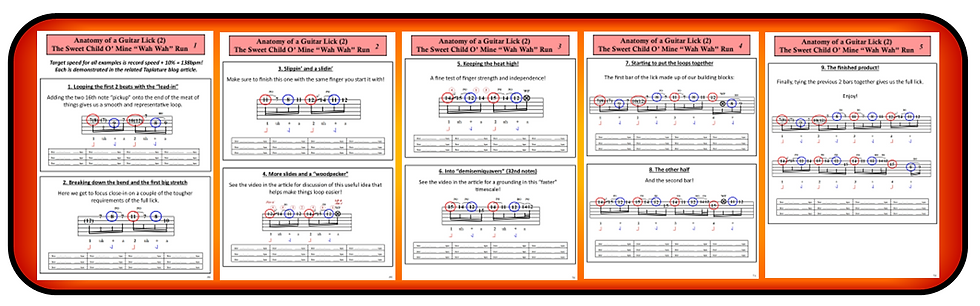
To make sure your practice is working we'll keep track of your top speed over time. Write down today's max so you don't forget it and your challenge becomes beating that high-score. To download ready-made progress sheets to keep track of your best speeds on all the examples shown here, click the image below:
If you can beat it next time then great ... keep doing what you're doing! If not then a little more digging is probably in order and the solution will undoubtedly be found among these 3 guitar practice principles.

"Keep track properly! I'm sending out ready-made benchmarking sheets for all the examples here in the Taplature blog to subscribers to this website"
A decent first target to have in mind for this single beat is to get it up to 50bpm. At that speed things are moving past too quickly to be able to consciously think and you have to "just do it!"
Longer term we're wanting 150bpm+ but of course, only without any loss of crispness or quality to your sound. Keep your ear on things, recording regularly to listen back to the sound you're making and how tightly you're locked-in with the beat.
One bar, One Chord
(When this full bar works we're almost there!)

This is hardly any different to what we've been doing up to now. The only real change is that we now need to keep the count going up throughout the bar, from 1 to 4, so we can keep track of which beat we're on.
I like to replace the "One" count with the name of the chord and I've also changed the "a" at the end of the count into an "an" since it rolls off the tongue better. Anything goes if it helps!
Click the video below for a demonstration:
Forget the guitar for a minute - try the count out loud with just your foot for company and see how fast you can get it looping while remaining sure that your foot taps tightly on the beat and lifts tightly on the offbeat (i.e. the "and") throughout. That will give you an idea of your top mental speed with this pattern (which is likely faster than the physical speed at which you can strum it ... for now!)
Bringing the guitar back into things will slow you down somewhat; make sure that your 16th-note count and foot-tap stay rock-solid, just like we programmed in above!
How to Apply the Pattern in Real Songs:
Adding In Chord Changes

"With the single-bar pattern above now fully-functional, we can use it to play almost any song you like. It covers you from the simplest, single-chord vamp, right up to the most complex sequences."

To play the whole of this classic floor-filler start to finish we just alternate two chords, E and B. We'll use the last 2 clicks of each bar to hide the change behind, getting ready for the new chord as we strum (see this article for plenty on that if it's unfamiliar).
All you need to think (or count out loud if easier) to keep it going is:
E + a 2 + a 3 + a 4 + a
B + a 2 + a 3 + a 4 + an
I've written the count in colour to highlight the foot pattern we've learned that keeps you tight with the metronome/backing; as always it's red for down, blue for up.
Click the video below for a demonstration:
And Now ... You Can Play Any Song This Way!
It's no real jump from our test example above to plug this pattern into any chord sequence, meaning you can now play thousands of songs on guitar in a 16th-note feel using only this one-beat generic strum pattern! I'll present this David Bowie classic as a reasonably-complex example since I've been enjoying using it a lot in lessons recently and the record itself uses 16th-notes throughout. We're not worried about the original strum pattern here; our new one will work just fine.

The first round of the verse section shown here has 7 bars which can be simply counted through as before, keeping the strum pattern ticking and changing chord as required. Let's just pick up on a couple of pointers on keeping the count rhythmic and straightforward:
1) Though the first chord is G minor it would spoil our count to try and say "G minor" on the one beat (too many syllables to fit nicely) so let's just say "G":
G + a 2 + a 3 + a 4 + a
2) In the 7th bar (with 2 beats of F and one each of Ab and Bb) we'll similarly simplify the unwieldy "A flat" and "B flat" chord names to "A" and "B" ... you'll still know where you need to be to play them.
Looping that bar to itself then, a strong, representative count is written out in full under this bar of Taplature:

Click the video below for a demonstration:

"This is the bar with the most chords in it so when it works, the rest of it is easy by comparison!
Get familiar with it on its own and then when you reach it in the song there's nothing to worry about."
A Longer Sequence but Nothing Really Changes
In the video below, I demonstrate stamping our single-beat pattern onto the full-verse chord-sequence of Starman (shown again above). Counting out loud as you go makes for a great way to keep track of where in the song you are and soon becomes an automated way of thinking.
The Full And Satisfying Backing from Learning Just One 16th-Note Beat!
Let's see how our simple 16th-note strum pattern sounds as the sole backing for Starman. I'll bring my vocal "talents" out of retirement to give this one a go. Click the video below to view:
Take It and Run with It!

"Having a collection of fallback strum patterns under your belt is a great way to feel comfortable in any musical setting. This one shouldn't take long to add to that collection. Once you've got it, you'll never be short of a quick way into any new 16th-note song you're learning!"
And Finally (Summary, Troubleshooting)
By this point, you've had a real workout for your "rhythm muscle".
Hopefully it's paid off and you have a lot of fresh insight into the intricacies of learning new patterns on guitar.
If you've run into any problems with anything presented here or if anything isn't clear then feel free to either comment below or join me in the Taplature Forum and I'll be on hand to offer some help.
Enjoy!
Old Swanner.


Comments